
How to Prepare for an Engineering Major in High School: A Step-by-Step Roadmap
Table of Contents
Engineering Preparation Starts Earlier
Many students believe choosing an engineering major begins in college. In reality, the preparation starts much earlier—and the students who plan ahead have a significant advantage.
Preparing for engineering in high school is not just about getting good grades. It is about building a combination of academic strength, technical skills, and real-world exposure.
The most effective students follow a structured path, gradually increasing both difficulty and depth.
Step 1: Choose the Right Academic Foundation for Engineering
Strong academic preparation is the foundation of any engineering path. However, not all courses carry the same weight.
Students aiming for an engineering major should prioritize rigor in math and science.
A typical strong progression includes:
- Math: Algebra → Geometry → Pre-Calculus → AP Calculus AB/BC
- Science: Biology → Chemistry → AP Physics (1, C Mechanics, or E&M)
- Additional: AP Computer Science A or AP Computer Science Principles
Among these, AP Physics and AP Calculus are especially important because they directly reflect the core thinking required in engineering.
Taking these courses signals readiness for technical coursework and shows that the student is willing to challenge themselves academically.
Step 2: Build a Strong Competition Profile
Competitions are one of the clearest ways to demonstrate ability in engineering-related fields.
Unlike regular coursework, competitions test how well students apply knowledge under pressure and in unfamiliar situations.
Some of the most relevant competitions include:
- FIRST Robotics Competition (FRC) – hands-on engineering and teamwork
- Science Olympiad – problem-solving across STEM disciplines
- Math Olympiad / AMC (AMC 10/12) – mathematical reasoning
- Regeneron Science Talent Search / Science Fair – research-based projects
Students do not need to win major awards at the beginning. What matters is consistent participation and improvement over time.
Competitions help students move from understanding concepts to applying them in real scenarios.
Step 3: Start Hands-On Engineering Projects Early
Engineering is fundamentally about building and testing ideas.
Students should not rely only on school assignments. Independent or team-based projects provide much deeper learning.
Examples of strong projects include:
- Building a simple robot or automated system
- Designing a small engineering prototype
- Creating coding-based tools or simulations
- Working on Arduino or Raspberry Pi systems
For students interested in modern engineering fields, exploring projects related to autonomous driving—such as basic object detection, sensor systems, or simple AI models—can be especially valuable.
These projects demonstrate initiative and show how students apply knowledge beyond the classroom.
Step 4: Learn Programming as a Core Skill
Programming is no longer optional in engineering—it is a foundational tool.
Students should aim to learn at least one programming language, such as:
- Python (recommended for beginners and AI-related work)
- Java (aligned with AP Computer Science A)
- C++ (commonly used in robotics and systems)
Programming strengthens logical thinking and allows students to work on more advanced engineering problems.
In fields like autonomous systems, programming becomes essential. Systems rely on algorithms to process data and make decisions in real time.
Step 5: Explore Engineering Fields Through Real-World Topics
Engineering is broad, and students benefit from exploring different areas early.
Instead of choosing randomly, students should focus on emerging or high-impact fields, such as:
- Robotics
- Artificial Intelligence
- Renewable Energy
- Autonomous Driving Systems
Exploring these areas helps students develop direction. It also allows them to connect academic learning with real-world applications.
For example, autonomous driving combines mechanical engineering, computer science, and data analysis—making it an ideal field for interdisciplinary exploration.
Step 6: Move Beyond Basic Projects Into Real Engineering Systems
By this stage, many students have completed basic projects—simple robots, coding exercises, or classroom assignments. While these are important, they often share a limitation: they are controlled, predictable, and relatively isolated.
Real engineering is different.
In real-world engineering, systems are interconnected. Problems are not clearly defined, and solutions require integrating multiple disciplines. For example, autonomous driving is not just about writing code or building hardware—it involves sensors, machine learning, data processing, and real-time decision-making working together as one system.
This is where many high school students encounter a gap.
They may understand programming, physics, or math individually, but they have not yet experienced how these elements combine into a functioning system. Without this exposure, it is difficult to fully develop the kind of thinking required for an engineering major.
A more advanced step is to move into environments where engineering is approached at the system level rather than as isolated tasks.
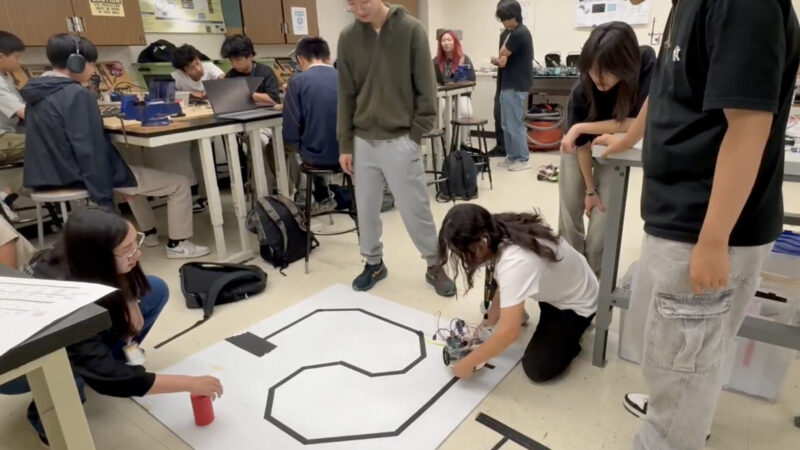
UC Irvine Autonomous Driving Camp introduce students to autonomous driving systems as an integrated engineering challenge. Instead of working on simplified exercises, students engage with how real engineering problems are structured—combining algorithms, sensors, and decision-making processes.
In this type of environment, students begin to understand how engineers actually think. They analyze inputs, design systems, test outcomes, and refine their approach based on results.
This transition—from completing small projects to working with complex systems—is one of the most important steps in preparing for an engineering major. It bridges the gap between foundational knowledge and real-world application.
Step 7: Build a Cohesive Engineering Narrative
By the time students apply to college, their experiences should form a clear story.
A strong engineering profile is not random. It shows progression.
For example:
- Early interest in math and science
- Participation in competitions
- Hands-on projects
- Exploration of a specific field like autonomous driving
This progression demonstrates both curiosity and commitment.
Colleges are not just looking at what students have done—they are looking at how those experiences connect.
People Also Ask
What AP classes should I take for an engineering major?
AP Calculus (AB/BC), AP Physics, and AP Computer Science are the most important courses for students preparing for an engineering major.
Do engineering colleges care about competitions?
Yes, competitions like robotics, math contests, and science fairs demonstrate problem-solving ability and initiative.
Is programming required for engineering students?
Programming is highly recommended, as it is used across many engineering fields, including robotics and autonomous systems.
What projects should high school students do for engineering?
Projects involving robotics, coding, electronics, or real-world problem-solving are especially valuable.
Engineering Preparation Is About Progression
Preparing for an engineering major is not about doing everything at once. It is about building skills step by step.
Students who focus on strong academics, meaningful projects, and real-world exposure develop a clear advantage. Over time, these experiences combine to form both capability and direction.
Engineering is ultimately about solving problems. The earlier students begin developing this mindset, the more prepared they will be for future challenges.
By submitting this form, you are consenting to receive marketing emails from: IvyMax, 41111 Mission Blvd., Suite 200, Fremont, CA, 94539, https://ivymax.com/. You can revoke your consent to receive emails at any time by using the SafeUnsubscribe® link, found at the bottom of every email. Emails are serviced by Constant Contact
Interested in our program?
Complete the form below and we’ll quickly respond with detailed information, and answers to all your questions!