
The Ultimate AP Exam Review Guide for the 2026 AP Exam Schedule
Table of Contents
2026 AP Exam Review
Historically, many students have relied on a delayed study strategy. They wait until their school’s Spring Break in April to purchase test preparation books and begin a concentrated period of last-minute studying. For the 2026 ap exam cycle, this delayed strategy will result in significantly lower scores.
The Advanced Placement testing landscape has fundamentally changed. College Board has accelerated its transition to digital testing, meaning that a traditional paper-and-pencil study approach is no longer effective. Securing a score of 5 on multiple exams now requires a highly organized, digital-first AP exam review strategy. High-achieving students in competitive California school districts must start their structured preparation immediately to manage the intense volume of curriculum and to master the new testing software. This comprehensive guide outlines the official dates, the technological shifts, and the exact 10-week methodology required to excel.
The Official 2026 AP Exam Schedule and Dates
The foundation of any successful AP exam review is a precise calendar. Students cannot allocate their study hours effectively without knowing exactly when each test occurs. In 2026, the College Board will administer exams over a two-week period in early May. Students taking three or more exams must map out their specific test days immediately to identify potential scheduling clusters.
Week 1 Testing Dates
The first week of testing covers several of the most popular STEM and Humanities subjects. Morning exams begin between 8:00 AM and 9:00 AM local time. Afternoon exams begin between 12:00 PM and 1:00 PM local time.
Monday, May 4, 2026:
Morning: AP Biology, AP Latin
Afternoon: AP European History, AP Microeconomics
Tuesday, May 5, 2026:
Morning: AP Chemistry, AP Human Geography
Afternoon: AP United States Government and Politics
Wednesday, May 6, 2026:
Morning: AP English Literature and Composition
Afternoon: AP Comparative Government and Politics, AP Physics 1: Algebra-Based
Thursday, May 7, 2026:
Morning: AP Physics 2: Algebra-Based, AP World History: Modern
Afternoon: AP African American Studies, AP Statistics
Friday, May 8, 2026:
Morning: AP Italian Language and Culture, AP United States History
Afternoon: AP Chinese Language and Culture, AP Macroeconomics
Note: Friday, May 8, 2026, at 8:00 PM ET is the final deadline for AP Art and Design students to submit their three portfolio components in the AP Digital Portfolio system.
Week 2 Testing Dates
The second week contains heavily enrolled math and science exams. Mental fatigue is a major factor during this week for students who also tested during Week 1.
Monday, May 11, 2026:
Morning: AP Calculus AB, AP Calculus BC
Afternoon: AP Music Theory, AP Seminar
Tuesday, May 12, 2026:
Morning: AP French Language and Culture, AP Precalculus
Afternoon: AP Japanese Language and Culture, AP Psychology
Wednesday, May 13, 2026:
Morning: AP English Language and Composition, AP German Language and Culture
Afternoon: AP Physics C: Mechanics, AP Spanish Literature and Culture
Thursday, May 14, 2026:
Morning: AP Art History, AP Spanish Language and Culture
Afternoon: AP Computer Science Principles, AP Physics C: Electricity and Magnetism
Friday, May 15, 2026:
Morning: AP Environmental Science
Afternoon: AP Computer Science A
Identifying Testing Conflicts and Back-to-Back Exams
Reviewing the schedule above is critical for identifying logistical challenges. Many students will discover they have “back-to-back” exams. For example, a student might be scheduled for AP Calculus BC on the morning of May 11 and AP Precalculus on the morning of May 12. Alternatively, a student might have a “double-header”—two exams on the exact same day, such as AP English Literature in the morning followed by AP Physics 1 in the afternoon on May 6.
A double-header requires six hours of intense cognitive output in a single day. A student’s AP exam review must include full-day stamina training. Practicing individual test sections is insufficient. Students with double-headers must complete two full-length practice tests on a single Saturday in April to condition their brains for the endurance required in May.
Critical Updates for the 2026 AP Exam Format
The most significant variable for the 2026 ap exam cycle is the College Board’s massive expansion of digital testing. As of this year, 28 AP exams have transitioned to the Bluebook digital testing application.
For subjects like AP United States History, AP English Language, AP Psychology, and AP Biology, the traditional paper test is completely obsolete. Students must take the exam on a school-issued or personal laptop. This format change introduces new technical and physiological challenges that must be addressed during the preparation phase.
Overcoming Digital Screen Fatigue
The transition from physical paper to a digital screen alters reading comprehension. Reading a dense, 600-word historical excerpt on paper allows a student to physically point to words, fold pages, and adjust the angle of the text to reduce glare. Reading that same text on a 13-inch laptop screen requires fixed posture and constant exposure to blue light.
During a three-hour exam, this leads to a documented phenomenon known as digital screen fatigue. Symptoms include eye strain, reduced reading speed, and lower information retention. Students who conduct their entire AP exam review using printed textbooks will experience a severe drop in performance during the second half of the digital exam. To combat this, students must incorporate digital reading and digital practice tests into their weekly study routines immediately.
Navigating the Bluebook Application Interface
The Bluebook application is not a simple word processor. It is a specialized testing environment with specific user interface tools. The software includes built-in digital highlighters, line-reference annotation pins, an integrated Desmos graphing calculator, and a specialized math equation editor.
Familiarity with these tools is mandatory. If a student waits until exam day to figure out how to input complex integral symbols into the Bluebook equation editor for AP Calculus, they will waste valuable minutes. A proper AP exam review involves downloading the Bluebook application early in the spring semester and completing timed practice modules exclusively within the software interface. This builds the required software navigation speed.
Digital Free Response Question Formatting Constraints
In previous years, the physical test booklet provided margins and blank pages where students could outline their Free Response Questions (FRQs) before writing the final essay. Students could draw arrows, cross out paragraphs, and visually structure their arguments.
The digital format changes this workflow. Students must type their FRQ responses directly into a designated text box. While digital scratch paper is sometimes provided by test proctors, the process of looking back and forth between physical scratch paper and the digital screen disrupts writing flow. Students who are slow typists or who are accustomed to handwriting their essays often produce disorganized digital responses that fail to hit the required scoring rubrics. Digital typing speed and on-screen essay outlining must be practiced weekly.
A 10-Week AP Exam Review Timeline for Maximum Retention
Cognitive science dictates that cramming is an ineffective study method for long-term retention. To master a year of college-level material, students must use spaced repetition. This means reviewing information at structured intervals over a prolonged period.
Starting in late February provides a 10-week runway to the May exams. The following timeline is the optimal structure for an effective AP exam review.
Weeks 1 to 2 Baseline Diagnostic Testing
The first two weeks of the timeline should be dedicated exclusively to data collection. Students should not begin reading textbooks or making flashcards yet. Instead, they must take one full-length, timed diagnostic test for every AP subject they are enrolled in.
The purpose of this baseline diagnostic testing is to practice High-Priority Topic Selection. High-achieving students frequently waste study hours reviewing concepts they already understand. The diagnostic test reveals specific knowledge gaps. If a student scores a 95% on the AP Biology unit covering Cellular Energetics but scores a 40% on the unit covering Gene Expression, the study plan must be adjusted to focus entirely on genetics. This targeted approach prevents wasted time.
Weeks 3 to 6 High-Priority Content Memorization
Once the knowledge gaps are identified, Weeks 3 through 6 are dedicated to intensive content review. This phase is critical for subjects with massive volumes of historical dates, vocabulary terms, or biological processes.
During this four-week block, students should study thematically rather than chronologically. For example, instead of reviewing AP United States History decade by decade, a student should review all Supreme Court cases from 1800 to 1990 in a single session. This thematic grouping helps the brain build connections, which is a required skill for the Document-Based Question (DBQ) sections of the exams. Students should use digital flashcards and active recall methods to ensure the information is committed to long-term memory.
Weeks 7 to 9 Intensive Free Response Question Practice
By Week 7, which typically aligns with early April, students must shift their focus away from multiple-choice questions and content memorization. The final weeks of an AP exam review must be dedicated to the Free Response Questions.
The FRQ section accounts for 50% of the total score on most AP exams. Knowing the correct scientific or historical fact is not enough; the student must communicate that fact using the exact terminology required by the College Board rubric. During Weeks 7, 8, and 9, students must write complete, timed FRQs every weekend. They must type these responses on a computer to simulate the Bluebook digital testing environment.
Week 10 Final Review and Mental Preparation
The final week before the 2026 ap exam dates is not for learning new material. Attempting to cram new information in the days immediately preceding the test increases cortisol levels and inhibits cognitive recall.
Week 10 should be treated as a taper week. Students should lightly review their formula sheets, read over their previously graded FRQs to remind themselves of formatting rules, and prioritize eight hours of sleep per night. Mental preparation and physical rest are the primary objectives during this final phase.
Why Self-Study Limits Your AP Exam Review Success
Many ambitious high school students attempt to execute their study plans independently. They download released exams from the College Board website and attempt to grade their own practice tests. While this method can work for the multiple-choice sections, it presents a critical vulnerability for the Free Response Questions.
Students possess an inherent confirmation bias when evaluating their own writing. When a student reads their own FRQ response, they know what they intended to communicate. Consequently, they often award themselves points even if the written explanation is vague or lacks the precise vocabulary required by the grading rubric.
The official College Board AP graders are instructed to follow strict, binary rubrics. If an AP Biology FRQ requires the specific phrase “conformational shape change” to earn a point, a student who writes “the protein changes how it looks” will receive a zero. A student studying alone cannot accurately simulate this strict grading environment. Without expert feedback from a trained instructor, a self-studying student will repeatedly practice incorrect writing habits. They will enter the exam room confident in their abilities, only to receive a score of 3 because they failed to understand the rigid expectations of the human graders.
The IvyMax AP Exam Review Solution
The transition to digital testing and the strict grading parameters of the College Board rubrics demand a professional preparation strategy. To ensure students are fully prepared for the upcoming May exams, IvyMax has launched our 2026 AP Review Courses. Designed as the all-in-one solution for your highest possible score, enrolling in these courses is a strategic step towards exam success.
Our comprehensive AP exam review program provides a targeted review of AP subjects and equips students with everything they need to excel:
Expert Instructors: Students receive personalized guidance from experienced instructors. The program includes dedicated Q&A sessions and personalized learning paths to address specific knowledge gaps.
Focused Content Review: The curriculum provides focused content understanding designed for efficient time management. Instructors deliver strategic tips and tricks to refine exam strategies and boost student confidence.
Simulated Exams: To overcome the challenges of the new testing format, our courses include simulated exams for practical experience. This practice maximizes your score potential and ensures successful performance on exam day.
Comprehensive 2026 Course Offerings
Whether a student needs help with a full-year subject or a specialized semester class, our curriculum covers all major disciplines.
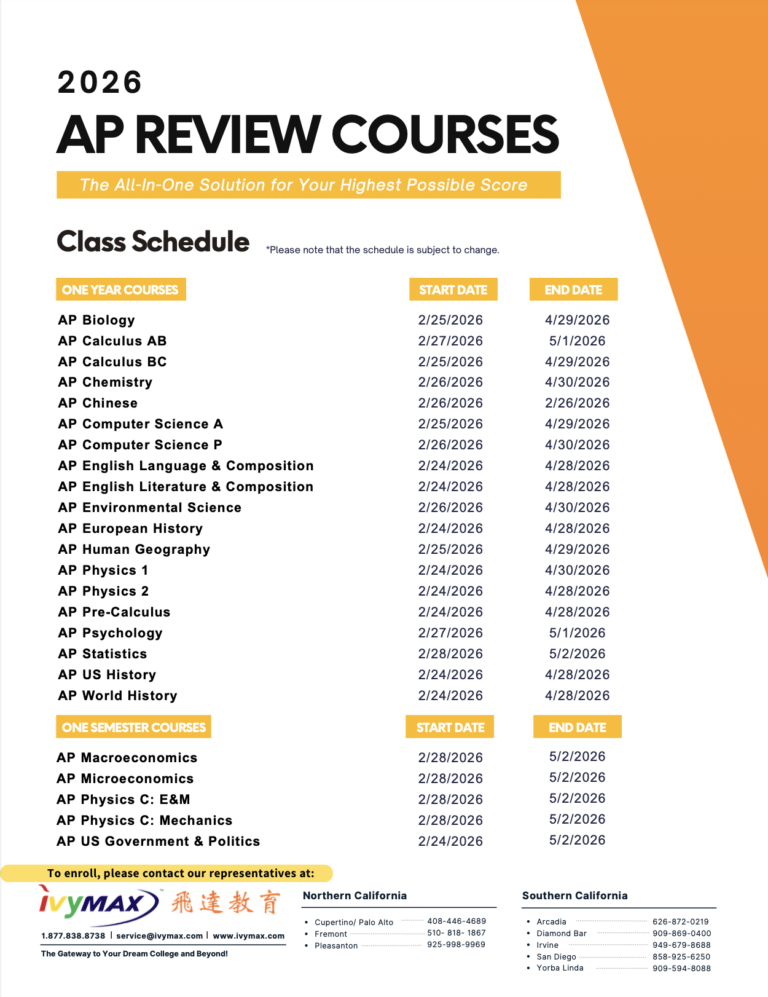
Our schedule features intensive One Year Courses, including AP Biology, AP Calculus AB, AP Calculus BC, AP Chemistry, AP Computer Science A, AP English Language & Composition, AP US History, and AP World History. Additionally, we offer specialized One Semester Courses, such as AP Macroeconomics, AP Microeconomics, AP Physics C: E&M, AP Physics C: Mechanics, and AP US Government & Politics.
Critical Enrollment Timeline
The window to prepare for the 2026 ap exam season is closing rapidly. Our 2026 AP Review Courses begin as early as February 24, 2026, and run through late April and early May 2026.
Let’s enroll today. There are limited spots available, so register now to invest in your AP Review Courses and secure your highest possible score. Contact IvyMax immediately to finalize your student’s spring schedule before classes reach capacity.
By submitting this form, you are consenting to receive marketing emails from: IvyMax, 41111 Mission Blvd., Suite 200, Fremont, CA, 94539, https://ivymax.com/. You can revoke your consent to receive emails at any time by using the SafeUnsubscribe® link, found at the bottom of every email. Emails are serviced by Constant Contact
Interested in our program?
Complete the form below and we’ll quickly respond with detailed information, and answers to all your questions!