
Best AP Classes for Computer Science Majors
Table of Contents
AP Classes for Computer Science Majors
Computer science preparation involves more than learning to code. Future CS majors also need strong skills in mathematics, algorithms, data, and problem solving, especially if they are interested in areas such as AI, data science, cybersecurity, robotics, or computer engineering.
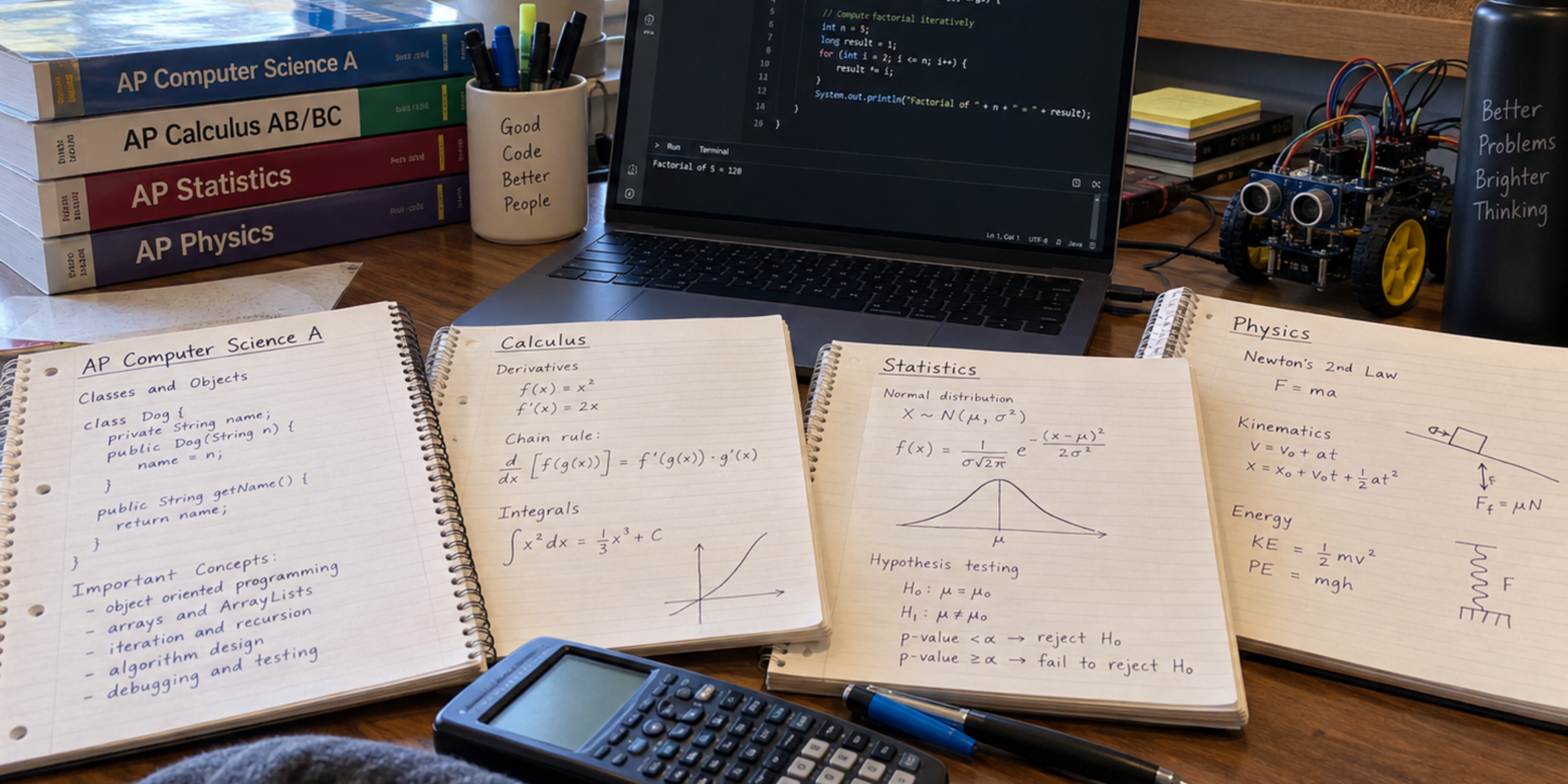
For most students, AP Computer Science A, AP Calculus AB or BC, AP Statistics, AP Physics, and AP Computer Science Principles are among the most useful choices. The best combination depends on the student’s preparation and intended area of interest.
A strong CS course plan should show clear academic progression rather than simply maximize the number of technical courses. Students should build from foundational programming and mathematics into more advanced coursework that supports their long term goals.
The Best AP Classes for Computer Science Majors
For most future computer science students, AP Computer Science A is the most directly relevant AP course. The course introduces students to programming using Java and develops skills in algorithm design, program development, debugging, object oriented programming, and data structures. College Board describes AP Computer Science A as comparable to a one semester introductory college computer science course, which makes it one of the clearest opportunities for high school students to experience the type of thinking they may encounter in an undergraduate CS program.
The value of AP Computer Science A is not simply that students learn Java. Programming languages change throughout a student’s academic and professional career. The more important skills are learning how to break a problem into smaller components, develop an algorithm, translate that algorithm into working code, identify errors, and explain why a program behaves as expected. Those habits are transferable to many later courses, regardless of whether the student eventually works in Python, C++, JavaScript, or another language.
AP Calculus AB or BC
AP Calculus AB or BC should also receive serious consideration. Many students and parents understandably associate computer science with coding, but university CS programs often require substantial mathematics. Calculus helps students develop comfort with functions, rates of change, mathematical modeling, and abstract quantitative reasoning. Students interested in artificial intelligence, graphics, scientific computing, robotics, computer vision, or other mathematically intensive areas may find that strong calculus preparation becomes especially valuable later.
AP Statistics
AP Statistics has become increasingly relevant as computer science expands into data driven fields. Modern software systems frequently use large datasets, probability models, experimentation, prediction, and statistical inference. Students who may eventually pursue data science, machine learning, artificial intelligence, quantitative research, or analytics can benefit from developing statistical thinking before college. AP Statistics does not replace university probability and statistics courses, but it can help students become comfortable reasoning about data and uncertainty.
AP Physics
AP Physics can be valuable as well, although its importance depends more heavily on the student’s intended direction. Traditional software engineering students may not need physics to the same degree as students interested in robotics, hardware, embedded systems, simulation, computer engineering, or certain areas of graphics. Students already studying calculus may consider AP Physics C when their mathematical preparation supports it, while other students may benefit from an algebra based physics course first.
AP Computer Science Principles can also play a useful role, particularly for students earlier in high school or those who have not previously studied computing. Rather than focusing as deeply on programming as AP Computer Science A, AP CSP introduces broader ideas in computing, data, abstraction, technology, and the social impact of computing. For some students it can serve as an accessible entry point before they move into more technically demanding coursework.
The key planning principle is that future CS students should think in terms of coding plus mathematics plus analytical problem solving. Computer science is broader than learning how to build an app, and a strong high school curriculum should reflect that breadth.
AP Computer Science A and AP Computer Science Principles
Families often ask whether students should take AP Computer Science A or AP Computer Science Principles. The two courses overlap in their general connection to computing, but their academic emphasis is different enough that students should not view them as interchangeable.
AP Computer Science Principles provides a broad introduction to computing. Students encounter programming, but they also study data, abstraction, computing systems, collaboration, and the ways technology affects individuals and society. It can work particularly well for students who are curious about technology but are not yet certain that they want to pursue computer science as a major. Students do not need previous coding experience to begin the course, which makes it accessible to younger students or those entering the subject for the first time.
AP Computer Science A is more focused on programming depth. Students work with Java and spend considerably more time designing programs, implementing algorithms, creating classes, working with objects, analyzing code, and debugging. For a student who already believes computer science may become a college major, AP CSA usually provides a more direct preview of traditional introductory CS coursework.
That does not mean every student should automatically skip CSP and move directly into CSA. Course sequence should depend on readiness. A ninth or tenth grader with little exposure to programming may benefit from taking CSP first and then CSA later. A student who already has significant programming experience outside school may find that CSP repeats concepts they already understand and may be ready for CSA sooner. College Board allows the two courses to be taken in either order, so schools and students have flexibility.
From IvyMax’s academic planning perspective, the more important question is not which course looks stronger on a transcript in isolation. The better question is whether the student’s sequence demonstrates continued development. CSP followed by CSA followed by more advanced mathematics, research, or specialized computing work creates a clear academic progression. Students should avoid selecting courses simply because the AP label appears impressive without considering where the course fits into their longer term development.
Why Math Matters for Future Computer Science Majors?
One of the most common misconceptions about preparing for computer science is that programming ability alone is enough. In reality, undergraduate computer science can be highly mathematical. Depending on the university and specialization, students may encounter discrete mathematics, linear algebra, probability, statistics, calculus, optimization, and mathematical proofs.
AP Calculus is therefore an important part of a strong computer science preparation plan. Students do not necessarily need AP Calculus BC simply because they intend to major in CS. A student should first reach the appropriate point in the school’s mathematics sequence and have the foundation needed to succeed. AP Calculus AB can be a rigorous and appropriate choice, while BC is often better suited to students who have progressed more rapidly through mathematics or who are considering particularly quantitative STEM pathways.
The same reasoning applies to AP Statistics. Statistics is no longer relevant only to students planning to become statisticians. Machine learning systems rely on probability and data. Product teams use experiments to compare outcomes. Data scientists analyze uncertainty, relationships, distributions, and models. Students interested in AI will eventually encounter mathematical concepts far beyond the AP Statistics curriculum, but learning to interpret data thoughtfully in high school provides a useful foundation.
For many future CS majors, the question should therefore not be Calculus or Statistics. Over a four year high school plan, the better goal may be to find room for both when the student’s preparation and schedule allow it. Calculus builds one type of quantitative maturity, while Statistics develops another. Students should prioritize the appropriate math sequence first and then add statistics when doing so does not force them into an unsustainable workload.
This is especially important because high school academic planning should prepare students for college rather than simply imitate it. Taking an advanced course too early can create gaps in understanding that become more difficult to correct later. A well paced sequence in mathematics is usually more valuable than accelerating solely for the purpose of reaching the highest possible AP course before graduation.
Choosing AP Classes for Different Computer Science Interests
Computer science has become broad enough that two students applying for CS may have very different academic interests. A student who wants to become a software engineer may need a different high school emphasis from one who is interested in artificial intelligence or computer hardware. AP course planning becomes more useful when families begin by considering the type of problems the student enjoys solving.
For students interested in traditional computer science or software engineering, AP Computer Science A should usually be a central course. Calculus is an important complementary subject because it strengthens mathematical maturity. AP Statistics can add useful data skills, while AP English Language or another writing intensive course can strengthen communication. Software engineers do not work in isolation from people, and the ability to explain a technical idea clearly is an important skill that students sometimes underestimate.
Students interested in artificial intelligence or data science should pay particular attention to mathematics. AP CSA can establish programming fundamentals, but AP Calculus and AP Statistics become increasingly important. Machine learning ultimately relies heavily on topics such as linear algebra, probability, calculus, and optimization. High school students are not expected to master all of these subjects before college, but a strong mathematics progression helps prepare them for the courses where those ideas will eventually appear.
For students considering robotics, computer engineering, hardware, or embedded systems, physics becomes more relevant. A combination of programming, calculus, and physics can provide a strong foundation because these areas frequently sit at the intersection of software and the physical world. AP Physics C may be especially useful for mathematically prepared students, although it should not be added before the student’s mathematics background supports the course.
Students interested in cybersecurity now have another potential pathway to consider. College Board has introduced AP Cybersecurity as an introductory college level cybersecurity course focused on areas such as protecting devices and networks, analyzing risk, detecting attacks, access controls, cryptography, and data protection. For students whose schools offer it, the course can complement broader computer science preparation. However, cybersecurity students still benefit from programming, mathematics, and core computing knowledge, so one specialized course should not replace the broader academic foundation.
The larger lesson is that students do not need identical schedules simply because they all intend to major in computer science. Course selection should begin with a solid base and then gradually reflect the student’s developing interests.
Computer Science AP Course Planning by Grade Level
A strong CS curriculum usually develops over several years. Students do not need to begin ninth grade with multiple AP courses to demonstrate interest in computer science. For many students, freshman year is better used to establish strong algebra skills, learn basic programming, explore technology, and develop good academic habits.
Grade 9
In Grade 9, a student who is new to computing may consider AP Computer Science Principles if the school allows freshmen to enroll and the workload is appropriate. Another student might take a regular programming course, join a robotics or coding activity, or learn introductory programming independently. At this stage, the objective should be exploration and foundation building rather than trying to maximize rigor immediately.
Grade 10
By Grade 10, students with sufficient mathematics preparation can begin moving toward AP Computer Science A. College Board recommends that CSA students have completed algebra and be familiar with functions. Students who took CSP earlier may be ready to progress to CSA, while students with substantial outside coding experience may enter CSA directly. Mathematics should continue progressing at the appropriate level at the same time.
Grade 11
Grade 11 is often when the academic profile becomes more specialized. A future CS major may take AP CSA if it has not already been completed, together with AP Calculus, AP Statistics, or an appropriate physics course. Students should resist the temptation to take every technical AP simultaneously. CSA, Calculus BC, Physics C, and Statistics can each require meaningful time. A demanding schedule is useful only when the student can actually engage with the material and maintain strong performance.
Grade 12
By Grade 12, students may be able to deepen the areas that interest them most. A student focused on AI might combine advanced mathematics with statistics or research. A student interested in robotics might continue with physics. A cybersecurity student may explore AP Cybersecurity if it is available. Students who have already exhausted their school’s CS curriculum may also pursue research, university level coursework, or structured outside study rather than repeating introductory content.
From an educational planning perspective, this progression matters because colleges can evaluate students within the opportunities available at their schools. A student whose school offers only one computer science course cannot be expected to follow the same path as someone attending a school with several advanced computing options. What students can control is whether they make thoughtful use of the opportunities that are realistically available to them.

How to Build a Strong CS Course Plan Without Overloading?
Computer science has become highly competitive at many universities, and this can lead families to assume that students should take every advanced STEM course available. That approach can backfire. Academic rigor is valuable, but the purpose of rigorous coursework is to demonstrate readiness and develop skills, not simply to accumulate difficult course titles.
Consider a student thinking about taking AP Computer Science A, AP Calculus BC, AP Physics C, AP Statistics, and several additional AP courses in the same year. That schedule may be entirely reasonable for a student who has progressed through the prerequisites, consistently performs at a high level, and has enough time to manage the workload. For another student, the same schedule may create unnecessary pressure and reduce both grades and learning quality. Course planning should therefore be individualized rather than based on a universal ideal schedule.
Students should also think about what they plan to do outside class. A student deeply involved in a robotics team, programming competition, research project, startup, internship, or substantial personal coding project may need time to develop those experiences. Filling every available hour with coursework can prevent students from applying their academic skills in meaningful ways.
At IvyMax, we view a strong CS academic profile as a combination of technical progression, mathematical readiness, intellectual depth, and sustained interests. A student who moves logically from introductory computing into programming and advanced mathematics while developing a meaningful area of interest often has a more coherent preparation than a student whose transcript contains many advanced courses without a clear direction.
Students should also avoid neglecting humanities and communication courses. Computer scientists write documentation, explain research, present ideas, collaborate with teams, debate ethical questions, and communicate with people who may not have technical backgrounds. A student can be highly quantitative and still benefit significantly from strong writing and analytical reading.
What to Do If Your School Does Not Offer the AP Courses You Need?
Access to advanced computer science coursework varies substantially among high schools. Some schools offer both AP Computer Science Principles and AP Computer Science A, while others may offer only one. Students may also run into timetable conflicts that make it difficult to combine computer science with advanced mathematics, laboratory science, or other required courses.
Similar limitations can affect Calculus, Statistics, Physics, and newer specialized subjects such as cybersecurity. When this happens, students should first evaluate whether the missing course is truly necessary for their intended academic direction. A student interested in software engineering may prioritize programming and mathematics, while a student interested in robotics may place greater value on physics.
Families can also investigate approved outside coursework, local college classes, summer study, online academic programs, independent research, or structured projects. However, students should not treat outside coursework as a way to accumulate credentials. The strongest alternative is one that solves a genuine academic limitation and allows the student to continue progressing in a logical direction.
This is also an area where long term planning can prevent unnecessary pressure. Students who identify potential scheduling conflicts early may be able to rearrange prerequisites, move a course to summer, or adjust the sequence of mathematics and science classes. Academic planning is most effective when students look several semesters ahead instead of making each course decision in isolation.
Frequently Asked Questions
What AP classes are best for computer science majors?
AP Computer Science A is the most directly related course for most future CS majors. AP Calculus AB or BC, AP Statistics, AP Physics, and AP Computer Science Principles can also provide valuable preparation. The best combination depends on the student’s math level, previous programming experience, intended specialization, and school curriculum.
Is AP Computer Science A important for a computer science major?
AP Computer Science A is one of the strongest high school courses for students seriously considering a computer science major because it develops programming and algorithmic problem solving skills. However, it is not a universal admission requirement. Students whose schools do not offer CSA can still build strong preparation through other programming coursework, advanced mathematics, and meaningful technical projects.
Should computer science students take AP Calculus?
Students planning to major in computer science should generally continue mathematics through the highest appropriate level available to them. Calculus can provide valuable preparation for college CS and related fields, particularly for students interested in AI, machine learning, graphics, scientific computing, robotics, or other quantitatively intensive areas.
Is AP Statistics useful for computer science?
Yes. AP Statistics can be particularly useful for students interested in artificial intelligence, data science, machine learning, experimentation, or analytics. It develops skills in probability, data analysis, inference, and interpreting uncertainty. Students should view statistics as complementary to their main mathematics progression rather than automatically replacing calculus.
Should students take AP Computer Science Principles before AP Computer Science A?
Not necessarily. AP CSP and AP CSA can be taken in either order. CSP can provide a useful broad introduction for students with little computing experience, while students who already have strong programming exposure may be ready to move directly into CSA. The appropriate sequence depends on the student’s preparation and the courses available at their school.
Is AP Physics important for computer science majors?
AP Physics can be valuable but is not equally important for every CS pathway. It can be particularly useful for students interested in robotics, computer engineering, simulation, hardware, or other areas connecting computing with physical systems. Students focused primarily on software may choose to prioritize computer science and mathematics courses first.
Final Thoughts
The best AP classes for computer science majors should help students develop more than programming experience. AP Computer Science A provides one of the most direct introductions to college level CS thinking, while Calculus and Statistics strengthen the mathematical foundation that becomes increasingly important in advanced computing fields. Physics can support students moving toward robotics and hardware, while AP Computer Science Principles can provide a broader introduction to computing for students who are earlier in their academic journey.
Students should also recognize that different areas of computer science require different preparation. Artificial intelligence and data science place greater emphasis on mathematics and statistics. Robotics and computer engineering benefit from physics. Cybersecurity introduces another combination of computing, systems, networks, and risk analysis. The best high school plan therefore becomes more specialized as the student’s interests become clearer.
Most importantly, students should avoid treating AP course planning as a competition to accumulate the largest possible number of advanced classes. Strong academic preparation develops through logical progression. Students should build programming skills, continue advancing in mathematics, explore the areas of computing they genuinely enjoy, and leave enough time to turn classroom knowledge into deeper projects and experiences.
For families planning several years ahead, the most useful question is not simply which AP class should come next. It is how each course fits into a broader academic pathway that supports the student’s interests, preparation, and future goals.
 Planning ahead? Check out AP Course Schedule:
By submitting this form, you are consenting to receive marketing emails from: IvyMax Inc, 41111 Mission Blvd., Suite 200, Fremont, CA, 94539, https://ivymax.com/. You can revoke your consent to receive emails at any time by using the SafeUnsubscribe® link, found at the bottom of every email. Emails are serviced by Constant Contact
Interested in our program?
Complete the form below and we’ll quickly respond with detailed information, and answers to all your questions!