
The Complete College Application Process for High School Students
Table of Contents
College Application Process
The college application process can feel overwhelming for high school students and families because it is not just one form, one essay, or one deadline. It is a multi-step journey that includes academic planning, college research, school list building, essay writing, recommendation letters, application forms, interviews, financial aid planning, portal tracking, and final decision-making.
For many students, the process begins with a simple question: “Where should I apply?” But as application season gets closer, that question becomes much more complex. Students must decide which colleges match their goals, which application deadlines to follow, how to present their activities, what to write in their essays, whom to ask for recommendation letters, and how to make sure every application is submitted correctly.
A strong college application is not created at the last minute. It is built step by step. The most successful applicants usually understand their academic profile, organize their materials early, write with reflection, and submit applications that clearly communicate who they are.
This guide explains the complete college application process for high school students, from early planning to final decisions. Whether you are a student preparing for senior year or a parent trying to understand what comes next, this article will help you see the full process more clearly.
What Is the College Application Process?
The college application process is the series of steps students complete to apply to colleges and universities. These steps usually include researching schools, creating a college list, preparing application materials, writing essays, requesting recommendation letters, completing application forms, submitting required documents, preparing for interviews, applying for financial aid, and tracking admissions decisions.
Most college applications include several common components. According to College Board, the combination of application materials helps admissions officers understand who the student is, though not every college requires every component. Common elements may include the application form, transcript, test scores if required or submitted, essays, recommendation letters, and activity information.
The college application process is different for every student because each applicant has different goals, academic strengths, family priorities, financial considerations, and college preferences. A student applying to public universities in California may follow a different process from a student applying to private liberal arts colleges, Ivy League universities, art schools, engineering programs, or international universities.
However, most students will go through the same major stages:
- Understanding their academic and extracurricular profile
- Building a college application timeline
- Researching and selecting colleges
- Organizing activities and awards
- Writing personal statements and supplemental essays
- Requesting recommendation letters
- Completing application platforms
- Reviewing and submitting applications
- Preparing for interviews
- Tracking portals and decisions
- Comparing acceptances, waitlists, and final enrollment options
The college application process is not only about getting into college. It is also about helping students understand who they are, what they value, and what kind of learning environment will help them grow.
Why the College Application Process Feels So Complicated
The college application process feels complicated because students are often managing several systems at once. One college may use the Common App. Another may use its own institutional application. The University of California system uses a separate UC application. Some colleges require supplemental essays, while others do not. Some require recommendation letters, interviews, portfolios, auditions, or additional program-specific materials.
Common App explains that first-year applicants can use the platform to build a college list, add colleges, engage counselors and recommenders, and complete required application sections. Many colleges also ask for recommendation letters and school forms submitted by counselors or teachers.
The process also feels difficult because college admissions can be holistic. Admissions officers may review grades, course rigor, essays, activities, recommendations, personal background, institutional needs, and other context. This means students cannot rely on one part of the application alone. A high GPA is important, but it does not automatically create a complete application. A strong essay is valuable, but it cannot fix an unrealistic school list or a rushed application form.
Another challenge is timing. Students must handle schoolwork, exams, extracurricular activities, family responsibilities, and applications at the same time. Without a clear timeline, even strong students can feel stressed and disorganized.
The best way to reduce stress is to understand the process early and divide it into manageable steps.
Step 1: Understand Your Application Profile
Before students choose colleges or start writing essays, they should understand their application profile. This is the foundation of the college application process.
An application profile includes the student’s academic performance, course rigor, test scores if applicable, extracurricular activities, leadership roles, awards, personal interests, intended major, writing ability, and long-term goals.
Students should ask themselves:
- What academic subjects have I consistently enjoyed or performed well in?
- What courses show my academic strengths?
- Have I challenged myself appropriately based on what my school offers?
- What activities have been most meaningful to me?
- Where have I shown leadership, initiative, creativity, service, or persistence?
- What major or academic direction am I considering?
- What personal qualities do I want colleges to understand?
- Are there any weaknesses or gaps I may need to explain?
- What makes my story different from other applicants with similar grades?
This step is important because students often begin the process by looking at rankings or copying another student’s school list. That approach can lead to poor fit. A college list should be based on the student’s actual academic profile, interests, goals, and preferences.
Understanding the application profile also helps with essays. A student who knows their strengths and themes can write more focused personal statements and supplemental essays. Instead of trying to sound impressive in a general way, the student can show specific evidence of curiosity, growth, leadership, or impact.
For example, a student interested in biology might identify a pattern of science coursework, lab experience, environmental volunteering, and independent reading. A student interested in business might notice a theme of leadership, entrepreneurship, communication, and problem-solving. A student interested in literature may recognize a pattern of writing, reading, language study, and cultural analysis.
The goal is not to force every part of the application into one narrow theme. The goal is to understand what the application already says and how to present it clearly.
Step 2: Build a College Application Timeline
A clear college application timeline helps students stay organized and avoid last-minute stress. Since different colleges have different deadlines, students should create a timeline early and update it regularly.
Most students should begin serious application planning during junior year. The summer before senior year is especially important because students can research colleges, finalize their school list, brainstorm essays, draft personal statements, and organize activities before school becomes busy again.
A general timeline may look like this:
9th and 10th Grade: Build the Foundation
During freshman and sophomore year, students should focus on academic habits, course selection, extracurricular exploration, and personal growth. At this stage, students do not need to obsess over college admissions, but they should begin building a strong foundation.
Important goals include:
- Taking appropriate courses
- Developing good study habits
- Exploring clubs, sports, arts, research, volunteering, or competitions
- Building relationships with teachers
- Identifying genuine interests
- Keeping a record of activities and achievements
11th Grade: Start Strategic Planning
Junior year is one of the most important years in the college application process. Students should begin researching colleges, preparing for standardized tests if needed, developing leadership roles, visiting campuses if possible, and thinking about possible essay topics.
Important goals include:
- Reviewing academic performance
- Planning senior-year courses
- Taking or preparing for SAT/ACT if relevant
- Researching colleges and majors
- Building a preliminary school list
- Continuing meaningful extracurricular involvement
- Identifying potential recommenders
- Starting financial aid conversations with family
Summer Before 12th Grade: Begin Applications
The summer before senior year is the best time to make major progress. Students should not wait until fall to begin essays.
Important goals include:
- Finalizing the college list
- Creating a deadline calendar
- Brainstorming personal statement topics
- Drafting the main essay
- Preparing UC Personal Insight Questions if applying to UC schools
- Researching supplemental essay prompts
- Organizing activities and awards
- Preparing a brag sheet for recommenders
Fall of 12th Grade: Submit Applications
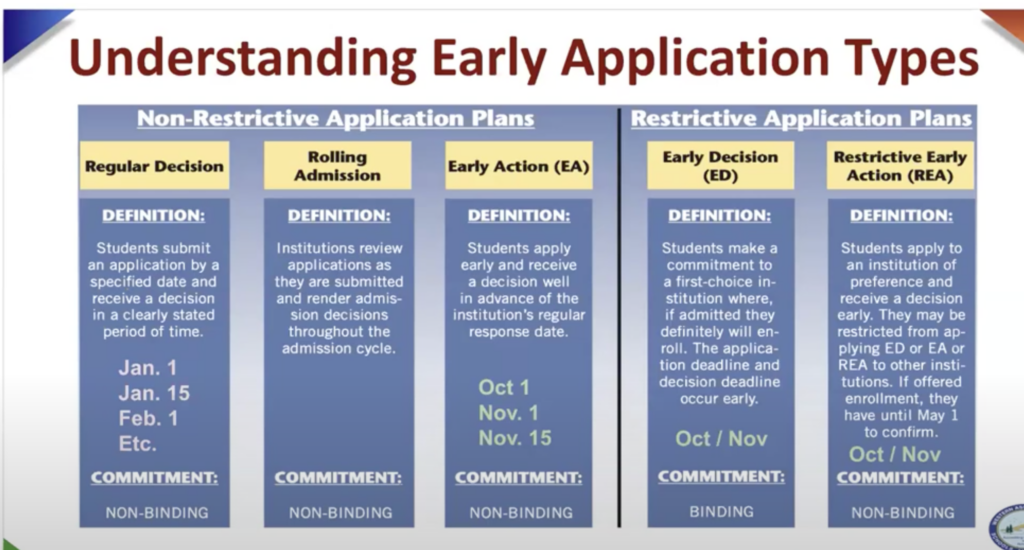
Senior fall is usually the most intense application period. Students may need to complete early action, early decision, UC, state university, private college, scholarship, and regular decision applications.
Important goals include:
- Finalizing essays
- Completing application platforms
- Requesting transcripts and recommendations
- Reviewing application forms
- Submitting early applications
- Submitting UC or other public system applications
- Preparing regular decision materials
- Tracking portals after submission
Winter and Spring of 12th Grade: Track Results and Decide
After applications are submitted, students must continue monitoring portals and emails. They may also need to prepare for interviews, submit updates, respond to waitlists, compare offers, and make a final decision.
Important goals include:
- Checking application portals
- Completing financial aid forms
- Preparing for interviews
- Reviewing admissions decisions
- Comparing financial aid packages
- Considering waitlist or appeal options
- Submitting the final enrollment deposit
A timeline makes the college application process more manageable because it turns a large, stressful project into smaller monthly tasks.
Step 3: Create a Balanced College List
Creating a college list is one of the most strategic parts of the college application process. A strong college list should include schools that fit the student academically, socially, financially, and personally.
Many families start with rankings, but rankings should not be the only factor. A famous university may not be the best fit for every student. A lower-ranked school may offer stronger support, better undergraduate teaching, more merit aid, a better major program, or a more comfortable campus culture.
A balanced college list usually includes:
Reach Schools
Reach schools are colleges where admission is highly competitive for the student’s profile. These may include selective universities with low acceptance rates or programs where the student’s grades, scores, or experience are below the typical admitted range.
Target Schools
Target schools are colleges where the student’s academic profile is reasonably aligned with the admitted student range. Admission is not guaranteed, but the student has a realistic chance.
Likely Schools
Likely schools are colleges where the student’s profile is stronger than the typical admitted range and where admission is more probable. These schools should still be places the student would be happy to attend.
A strong list should also consider:
- Intended major
- Academic programs
- Campus size
- Location
- Weather
- Cost
- Financial aid
- Internship opportunities
- Research access
- Study abroad
- Campus culture
- Diversity and student life
- Housing
- Career outcomes
- Family preferences
Students should also understand that selectivity can vary by major. Computer science, engineering, business, nursing, architecture, and certain arts programs may be more competitive than the overall university acceptance rate suggests.
A balanced college list protects students from two common mistakes: applying only to highly selective schools or applying to schools without understanding fit. The goal is to create options.
Step 4: Understand College Application Requirements
Each college has its own application requirements. Students should review requirements carefully for every school on their list.
Common requirements may include:
- Application form
- High school transcript
- Senior-year course list
- Activities list
- Personal statement
- Supplemental essays
- Recommendation letters
- Counselor report
- SAT or ACT scores, if required or submitted
- English proficiency test, if applicable
- Portfolio, audition, or writing sample for certain majors
- Application fee or fee waiver
- Financial aid forms
College Board notes that not every college requires every application element, so students should check each school’s specific requirements.
This step is especially important because two colleges using the same platform may still have different requirements. For example, one Common App college may require two teacher recommendations and three supplemental essays, while another may require no teacher recommendations and only one short answer.
Students should create a spreadsheet or tracking document with columns for:
- College name
- Application platform
- Deadline
- Application plan
- Essay requirements
- Recommendation requirements
- Test policy
- Portfolio or interview requirements
- Financial aid deadline
- Portal login
- Submission status
This tracking system will become increasingly important as deadlines approach.
Step 5: Plan Your Academic Story
Academic performance is one of the most important parts of the college application process. Colleges review transcripts to understand grades, course rigor, academic progression, and preparation for college-level work.
However, students should not think of academics only as numbers. The transcript tells a story. It shows what subjects the student pursued, whether they challenged themselves, how they performed over time, and how their choices connect to future goals.
Students should review:
- GPA trends
- Strength of curriculum
- AP, IB, honors, dual enrollment, or advanced courses
- Senior-year course choices
- Major-related coursework
- Academic awards
- Research or independent study
- Any unusual circumstances affecting grades
A student applying for engineering should ideally show strong preparation in math and science. A student applying for humanities should show strength in reading, writing, language, history, or research. A student applying for business may benefit from coursework or activities connected to math, economics, leadership, entrepreneurship, or communication.
Students do not need to be perfect. Admissions officers understand that students grow over time and that schools offer different opportunities. But students should be thoughtful about how their academic choices support their application.
If there is a drop in grades, a scheduling limitation, a health issue, a family responsibility, or another important context, students may need to explain it appropriately in an additional information section or counselor context. The explanation should be clear and factual, not defensive.
Step 6: Organize Activities and Awards
Activities and awards help colleges understand what students do outside the classroom. This section can show leadership, initiative, responsibility, creativity, teamwork, service, curiosity, and impact.
Many students think they need a long list of impressive activities. In reality, quality matters more than quantity. Colleges often value depth, consistency, and impact over scattered participation.
Strong activities may include:
- Clubs
- Sports
- Music
- Art
- Debate
- Research
- Internships
- Volunteer work
- Family responsibilities
- Part-time jobs
- Community projects
- Competitions
- Student government
- Cultural or religious activities
- Independent projects
- Online learning
- Creative work
- Entrepreneurship
Students should describe activities using action and impact. Instead of writing only “member of robotics club,” a stronger description might explain that the student designed a component, led a subteam, mentored younger members, organized outreach, or competed at a specific level.
When organizing activities, students should ask:
- What did I actually do?
- How much time did I spend?
- What responsibilities did I have?
- Did I lead, create, organize, teach, research, build, perform, compete, or serve?
- What changed because of my involvement?
- Which activities best represent my interests and values?
Students should also organize awards carefully. Awards may be academic, artistic, athletic, service-based, school-based, regional, national, or international. If an award is not widely known, students should briefly clarify its meaning or level.
The activities section should not exaggerate. It should present real experiences in a clear and compelling way.
Step 7: Develop a Clear Application Narrative
A strong college application should feel connected. This does not mean every activity, essay, and class must relate to the same topic. It means the application should help admissions officers understand the student’s identity, strengths, and direction.
An application narrative is the central impression the student wants to leave.
For example:
- A future engineer may show curiosity, problem-solving, robotics experience, math strength, and a desire to build useful technology.
- A future public health student may show biology interest, community service, research, and concern for health equity.
- A future writer may show reading, journalism, storytelling, cultural reflection, and strong communication.
- A future business student may show leadership, entrepreneurship, teamwork, and analytical thinking.
- An undecided student may show intellectual curiosity, adaptability, interdisciplinary interests, and openness to exploration.
A clear narrative helps students make decisions about essays, activities, recommendations, and interviews. It prevents the application from feeling like a random collection of achievements.
However, students should be careful not to make the narrative too rigid. A real student is multidimensional. The goal is not to reduce the student to one label. The goal is to help the application feel intentional and memorable.
Step 8: Write the Personal Statement
The personal statement is one of the most important writing pieces in the college application process. It gives students a chance to speak directly to admissions officers in their own voice.
The Common App allows first-year students to apply through a shared platform and complete application sections used by multiple colleges. Students may also need to complete college-specific questions and writing supplements depending on the schools they add.
A strong personal statement should reveal something meaningful about the student. It should not simply repeat the activities list or summarize achievements. It should help the reader understand how the student thinks, what they value, how they have grown, or what experiences shaped them.
Good personal statement topics can come from:
- A meaningful challenge
- A moment of growth
- A personal interest
- A family or cultural experience
- A question that changed the student’s thinking
- A responsibility that shaped maturity
- A creative or intellectual pursuit
- A community experience
- A small but revealing moment
Students often believe they need a dramatic story. That is not true. A quiet, specific, reflective essay can be stronger than a dramatic essay with little self-awareness.
Common personal statement mistakes include:
- Writing a résumé in paragraph form
- Choosing a topic only because it sounds impressive
- Spending too much time describing the event and not enough time reflecting
- Using clichés
- Trying to sound like someone else
- Writing a generic lesson at the end
- Overusing abstract words without concrete details
- Ignoring the student’s real voice
A strong personal statement usually includes specific details, honest reflection, and a clear sense of personal growth. The essay should feel like only that student could have written it.
Step 9: Write Supplemental Essays
Supplemental essays are school-specific or program-specific essays required by individual colleges. They are a major part of the college application process because they help colleges understand why the student is interested in that institution, major, or community.
Common supplemental essay types include:
“Why This College?” Essays
These essays ask why the student wants to attend a specific school. Strong responses should include specific academic programs, courses, professors, research opportunities, student organizations, campus values, or community features. Generic praise is not enough.
Weak answer:
“I want to attend this university because it is prestigious and has excellent academics.”
Stronger answer:
“I am drawn to the university’s interdisciplinary data science curriculum, undergraduate research opportunities in computational biology, and student-led health technology organization because they connect directly to my interests in biology and machine learning.”
“Why This Major?” Essays
These essays ask why the student wants to study a particular field. Strong responses should show curiosity, preparation, and future direction.
Students should explain:
- What sparked the interest
- How they explored it
- What questions they want to continue studying
- How the college’s program supports that goal
Community Essays
These essays ask how the student has contributed to or been shaped by a community. The community can be cultural, geographic, academic, family-based, social, creative, or personal.
Strong community essays show both belonging and contribution.
Challenge Essays
These essays ask about obstacles, setbacks, or difficult experiences. Strong challenge essays focus less on the problem itself and more on the student’s response, growth, and perspective.
Intellectual Curiosity Essays
These essays ask what ideas, questions, books, experiments, or academic interests excite the student. Strong responses show genuine thinking, not just achievement.
Supplemental essays should not repeat the personal statement. Each essay should reveal a different dimension of the student.
Step 10: Prepare UC Personal Insight Questions or Other System-Specific Essays
Some application systems have their own essay formats. The University of California application is one of the most important examples for students applying to UC campuses.
UC first-year applicants answer four out of eight Personal Insight Questions, and each response has a 350-word limit. UC states that all questions are given equal consideration, so students should choose the questions most relevant to their experiences.
UC PIQs are different from the Common App personal statement. They are shorter, more direct, and often more focused on specific experiences or qualities. Students should avoid writing one long personal statement and splitting it into four parts. Instead, each PIQ should highlight a distinct strength or experience.
Strong UC PIQs often show:
- Leadership
- Creativity
- Talent or skill
- Educational opportunity or challenge
- Significant challenge and response
- Academic interest
- Community contribution
- Personal quality or strength
Because the responses are short, students should be clear and specific. They should answer the prompt directly, include concrete evidence, and explain why the experience matters.
Other systems may also have unique writing requirements. Some honors colleges, scholarship programs, art schools, or special programs require additional essays, portfolios, research statements, or short responses. Students should identify these requirements early so they do not discover them close to the deadline.
Step 11: Request Recommendation Letters
Recommendation letters help colleges understand how students interact with teachers, contribute to classrooms, handle challenges, and demonstrate character. Not every college requires recommendation letters, but many selective colleges do.
Students should choose recommenders carefully. The best recommender is not always the teacher who gave the highest grade. A strong recommender should know the student well and be able to write with specific examples.
Students should consider asking teachers who can describe:
- Intellectual curiosity
- Work ethic
- Classroom participation
- Writing or analytical ability
- Collaboration
- Leadership
- Growth over time
- Character
- Major-related strengths
Students should request recommendation letters early, ideally before the busiest part of senior fall. They should ask politely and give teachers enough time.
A student may also prepare a brag sheet. This document can include:
- Academic interests
- Intended major
- Important activities
- Major achievements
- Personal qualities
- Specific classroom memories
- Projects or papers from the class
- Future goals
- Application deadlines
The brag sheet should help the teacher write a more detailed letter. It should not tell the teacher exactly what to say.
Students should also remember the counselor recommendation. Counselors may need information about the student’s background, course choices, activities, and goals. Since counselors often support many students, early communication is important.
Step 12: Complete Application Platforms
Application platforms are where students enter information, upload essays, invite recommenders, select colleges, and submit applications.
Common platforms include:
- Common App
- University of California application
- Coalition Application
- ApplyTexas
- Cal State Apply
- Individual college portals
- Scholarship or honors college applications
College Board notes that online application forms and services such as the Common Application and Coalition can allow students to complete one application for multiple schools.
Students should complete application forms carefully. Application platforms may ask for:
- Personal information
- Family information
- Citizenship or residency information
- High school information
- Course history
- Current courses
- Test scores
- Activities
- Honors
- Essays
- Major choices
- Campus choices
- Recommendation invitations
- Fee waiver information
Common mistakes include:
- Entering courses incorrectly
- Forgetting to assign recommenders
- Missing school-specific questions
- Selecting the wrong major
- Confusing early action and early decision
- Forgetting to preview the application
- Submitting without proofreading
- Missing scholarship questions
- Assuming one application automatically applies to every program
Students should not rush this stage. Even if essays are strong, errors in the application form can create problems.
Step 13: Review Before Submission
Before submitting any application, students should complete a careful final review. This is one of the most important steps in the college application process.
Students should check:
- Name and personal information
- High school information
- Course entries
- Current senior-year courses
- Activities and descriptions
- Honors and awards
- Essay formatting
- Supplemental essay responses
- Major selection
- Campus selection
- Recommendation status
- Test score reporting
- Deadline
- Application fee or fee waiver
- Preview PDF, if available
Students should also check for consistency. For example, if an essay says the student wants to study neuroscience, but the selected major is economics, there should be a clear reason. If an activity description says the student participated for four years, the grade levels should match. If a supplemental essay mentions the wrong college name, that is a serious error.
Students should avoid submitting seconds before the deadline. Technical problems can happen. A safer approach is to submit at least a few days early whenever possible.
Step 14: Prepare for College Interviews
Some colleges offer interviews as part of the admissions process. Interviews may be required, recommended, optional, or unavailable depending on the school.
A college interview may be conducted by:
- Admissions officers
- Alumni interviewers
- Current students
- Faculty members
- Program representatives
Interviews may be evaluative or informational. An evaluative interview can become part of the admissions file. An informational interview may be more focused on helping the student learn about the school. Students should prepare either way.
Common college interview questions include:
- Tell me about yourself.
- Why are you interested in this college?
- What academic subjects interest you most?
- What activities are most meaningful to you?
- What is a challenge you have faced?
- How would your friends or teachers describe you?
- What do you hope to contribute to campus?
- What do you like to do outside school?
- What questions do you have for me?
Strong interview preparation should not involve memorizing a script. Instead, students should practice speaking clearly about their experiences, interests, and goals.
Students should prepare:
- A short self-introduction
- Reasons for interest in the college
- Academic interests
- Meaningful activities
- Examples of leadership or growth
- Questions to ask the interviewer
- A polite thank-you message after the interview
A good interview should feel like a conversation. The student should be respectful, specific, thoughtful, and authentic.
Step 15: Apply for Financial Aid and Scholarships
Financial aid is an important part of the college application process for many families. Students should understand the difference between admissions applications and financial aid applications. Being admitted to a college does not automatically mean the student has completed financial aid requirements.
Common financial aid forms may include:
- FAFSA
- CSS Profile
- State aid forms
- Institutional financial aid forms
- Scholarship applications
- Verification documents
The FAFSA is used to apply for federal student aid, and Federal Student Aid provides official FAFSA deadlines by state and aid program. State and institutional deadlines may differ, so families should check each college and state requirement carefully.
Students should also research merit scholarships. Some colleges automatically consider applicants for merit aid, while others require separate scholarship applications or earlier deadlines.
Financial aid planning should begin early because families may need tax information, income details, assets, identification numbers, and parent contributor information. Missing a financial aid deadline can reduce available aid.
Students should add financial aid deadlines to the same tracking document used for application deadlines.
Step 16: Track Application Portals After Submission
Submitting the application is not the end of the college application process. After submission, most colleges send students instructions to create or access an application portal.
The portal may show:
- Application status
- Missing materials
- Transcript status
- Recommendation status
- Test score status
- Financial aid documents
- Interview invitations
- Scholarship updates
- Admissions decisions
Students should check portals regularly and monitor email carefully. Sometimes colleges request additional materials or clarification. If students miss these messages, their application may remain incomplete.
Students should create a tracking document with:
- Portal URL
- Username
- Date account was created
- Materials received
- Missing items
- Financial aid status
- Interview status
- Decision date
Students should also use a professional email address and check spam folders. Many important college messages arrive by email.
Step 17: Understand Admissions Decisions
Admissions decisions can include acceptance, denial, waitlist, deferral, or spring admission, depending on the college.
Acceptance
An acceptance means the student has been admitted. The student should review the offer carefully, including major, campus, financial aid, honors program status, housing, and enrollment deadlines.
Denial
A denial means the student was not admitted. This can be disappointing, but it does not define the student’s ability or future success. Admissions decisions are influenced by many factors beyond the student’s control.
Deferral
A deferral usually happens in early application rounds. It means the application will be reviewed again in the regular decision pool. Students may need to submit updated grades, a letter of continued interest, or other materials if allowed.
Waitlist
A waitlist means the college may admit the student later if space becomes available. Students should follow the college’s instructions carefully. Some colleges allow a letter of continued interest; others do not.
Appeal
Some colleges allow appeals under limited circumstances. Appeals are usually appropriate only when there is new, significant information or a clear error. Students should review each college’s appeal policy before submitting anything.
After decisions arrive, students should compare options thoughtfully. The best choice is not always the most famous school. Students should consider academic fit, cost, location, support, career opportunities, student life, and personal comfort.
College Application Checklist
A checklist helps students manage the college application process step by step.
College Research
- Research majors and academic programs
- Compare college size, location, culture, and cost
- Review admissions requirements
- Attend information sessions or campus tours if possible
- Build a balanced college list
Application Planning
- Create a deadline calendar
- Identify application platforms
- Choose early action, early decision, regular decision, or rolling admissions plans
- Review scholarship and financial aid deadlines
- Track each college’s requirements
Academic Materials
- Review transcript
- Confirm senior-year courses
- Decide whether to submit test scores
- Request transcripts
- Prepare explanations for academic context if needed
Activities and Awards
- List all activities from high school
- Identify leadership and impact
- Select the strongest activities
- Write concise descriptions
- Organize awards by importance
Essays
- Brainstorm personal statement topics
- Draft and revise the main essay
- Write supplemental essays
- Complete UC PIQs if applicable
- Proofread every essay
- Confirm each essay matches the correct college
Recommendations
- Choose teacher recommenders
- Ask early and politely
- Prepare a brag sheet
- Confirm counselor forms
- Track recommendation submission status
Application Forms
- Complete personal and family information
- Enter courses accurately
- Add activities and honors
- Upload essays
- Select majors and campuses
- Review school-specific questions
- Preview application before submission
After Submission
- Create portal accounts
- Check for missing materials
- Monitor email
- Prepare for interviews
- Submit financial aid forms
- Track decisions
- Compare offers
- Respond by enrollment deadlines
Common Mistakes to Avoid During the College Application Process
Even strong students can make mistakes if they rush or lack organization. Here are some of the most common mistakes.
Waiting Too Long to Start
Students who wait until senior fall to begin the process often feel overwhelmed. Essays, applications, recommendations, and deadlines take more time than expected.
Building a College List Based Only on Rankings
Rankings do not show whether a college is the right fit. Students should consider academics, culture, cost, location, support, and personal goals.
Applying Only to Reach Schools
A list with only highly selective schools is risky. Students should include target and likely schools they would genuinely be happy to attend.
Writing Generic Essays
Generic essays often sound polished but forgettable. Strong essays include specific details, reflection, and personal voice.
Repeating the Same Information
Students should use different application sections to show different strengths. Essays should not simply repeat the activity list.
Ignoring Supplemental Essays
Supplemental essays are often very important because they show fit. Students should research each college carefully.
Asking Recommenders Too Late
Teachers and counselors need time. Students should ask early and provide helpful information.
Submitting Without Reviewing
Small mistakes can hurt an application. Students should preview every application before submission.
Forgetting Portals After Submission
Application tracking continues after submission. Students must check portals and emails regularly.
Missing Financial Aid Deadlines
Financial aid forms may have different deadlines from admissions applications. Families should track them separately.
Avoiding these mistakes can make the process smoother and reduce unnecessary stress.
When Families May Need Extra Support
Some students can manage the college application process independently with school resources, family support, and careful planning. Others may benefit from additional guidance, especially when the process feels complex or high-stakes.
Families may seek support when:
- The student is applying to many colleges
- The school list is unclear
- The student is unsure how to choose a major
- Essays feel difficult to brainstorm or organize
- The student has many activities but no clear narrative
- Parents are unfamiliar with the U.S. admissions system
- The student is applying to selective universities
- The student needs interview preparation
- The family wants help tracking deadlines and progress
- The student needs a final review before submission
College application support should not replace the student’s own voice or effort. Instead, good guidance helps students understand the process, organize their materials, and present themselves clearly.
How IvyMax CAP Supports the College Application Process
For families who want structured guidance, IvyMax’s College Application Program, also known as CAP, supports students through the full college application process. CAP is designed for students who need more than essay editing. It helps students manage the process from planning to submission and beyond.
IvyMax CAP may include personalized application timeline planning, customized college list development, course planning guidance, extracurricular activity tracking, essay brainstorming, one-on-one writing guidance, recommendation letter strategy, application system support, full application review, interview preparation, parent meetings, application progress tracking, admissions result analysis, and appeal letter guidance when appropriate.
This full-process support is useful because college applications are connected. The college list affects the essay workload. The intended major affects activity positioning. The activity list influences essay strategy. Recommendation letters should support the student’s broader application story. Interview preparation should reinforce the same qualities shown in the written application.
Rather than treating every task separately, CAP helps students approach the process with structure. Students can better understand what needs to be done, when to do it, and how each part of the application fits together.
For parents, CAP also provides communication and progress updates, which can reduce uncertainty during a stressful season. For students, it offers guidance while still keeping the student’s own voice and responsibility at the center of the process.
IvyMax CAP is not about creating a formulaic application. It is about helping each student present their real academic interests, personal strengths, and future potential in a clear and organized way.
Frequently Asked Questions About the College Application Process
What is the college application process?
The college application process is the complete set of steps students complete to apply to colleges. It includes researching schools, building a college list, preparing essays, requesting recommendations, completing application forms, submitting materials, tracking portals, preparing for interviews, and reviewing admissions decisions.
When should high school students start the college application process?
Students should begin general preparation in 9th and 10th grade by building strong academic habits and exploring interests. Serious application planning usually begins in 11th grade, and essay writing often begins during the summer before 12th grade.
What is the most important part of the college application process?
There is no single most important part for every student. Grades, course rigor, essays, activities, recommendations, and fit can all matter. A strong application presents these parts clearly and consistently.
How many colleges should students apply to?
The right number depends on the student’s goals, major, academic profile, budget, and application workload. Many students apply to a balanced mix of reach, target, and likely schools.
What should students write about in college application essays?
Students should write about experiences, interests, values, challenges, or moments of growth that reveal who they are. The best essays are specific, reflective, and personal.
Are interviews required for college applications?
Some colleges require or recommend interviews, while others do not offer them. Students should check each college’s policy and prepare if an interview is available.
What happens after students submit applications?
Students should create portal accounts, check for missing materials, monitor email, complete financial aid forms, prepare for interviews, and track decision dates.
The college application process is one of the most important academic projects high school students will complete. It requires planning, organization, reflection, writing, communication, and follow-through. Students must understand their profile, build a balanced college list, prepare strong essays, request thoughtful recommendations, complete application forms accurately, prepare for interviews, and track decisions carefully.
The process can feel overwhelming, but it becomes much more manageable when students break it into clear steps. Starting early, staying organized, and understanding the purpose of each application component can reduce stress and improve the quality of the final submission.
A strong college application is not simply a list of achievements. It is a thoughtful presentation of who the student is, what they have done, what they value, and how they may contribute to a college community.
For high school students and families, the best approach is to treat the college application process as a journey. Each step matters, and each step gives students an opportunity to understand themselves more deeply and communicate their story more clearly.
These courses not only build the skills needed to succeed in competitions like F=ma, but they also demonstrate academic rigor on college applications—especially for students aiming to enter STEM majors at top universities.
Interested in our program?
Complete the form below and we’ll quickly respond with detailed information, and answers to all your questions!